
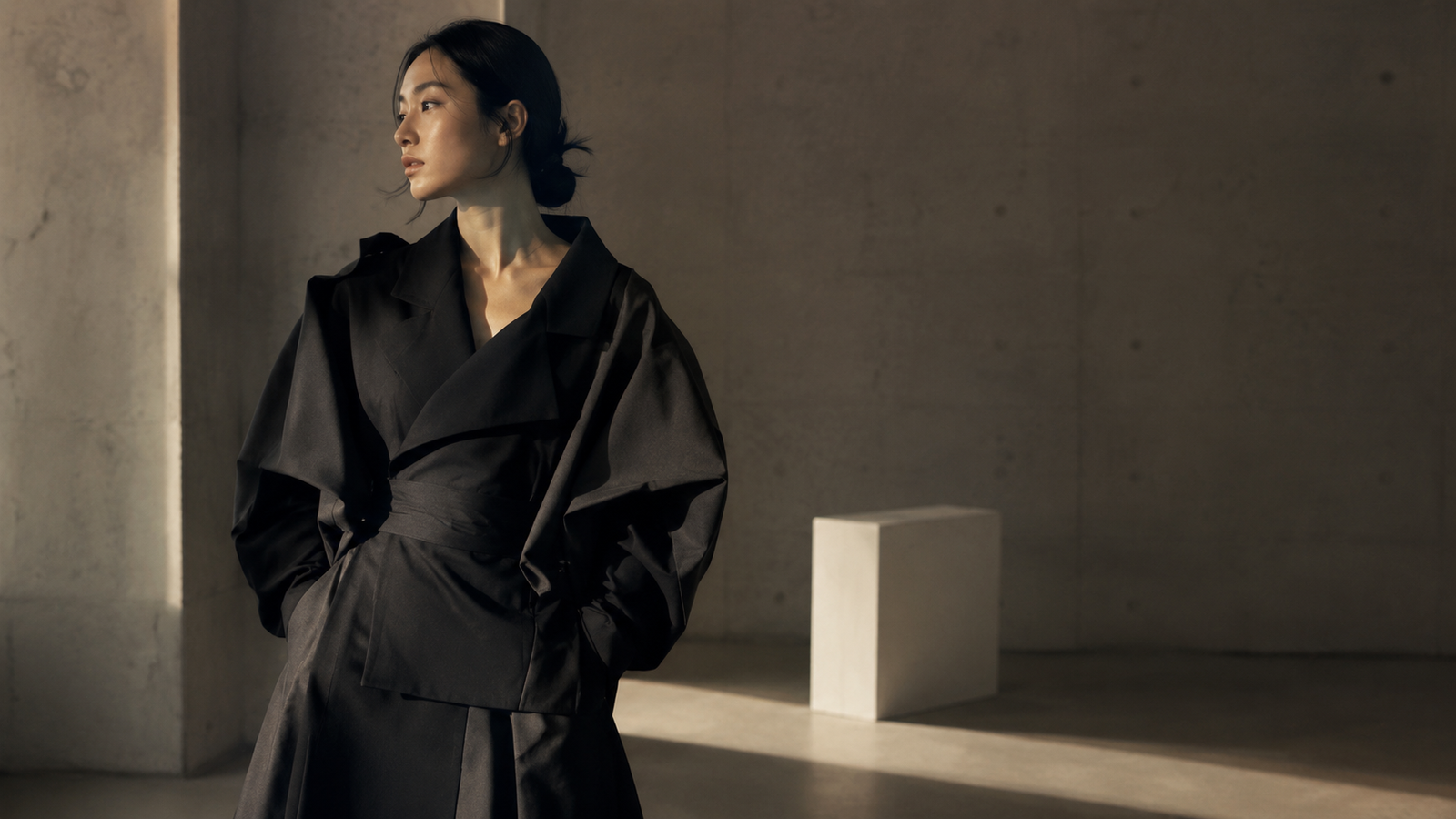
In March 2026, BTS performed their comeback stage in Songzio. The collection, titled “Lyrical Armor,” drew on Korean warrior heritage — hanbok silhouettes reworked into abstracted armor construction, traditional garment vocabulary applied to performance wear built for a stadium. It was not the international fashion press’s dominant story that month. European houses with larger communications departments and more aggressive editorial seeding generated more column inches.
But the largest cultural act in the world choosing a Seoul-born luxury house over any European brand for their most-watched performance of the decade is a data point worth examining carefully. Songzio has been presenting at Paris Fashion Week since 2006. It opened a men’s flagship in central Paris in 2024, a women’s store in 2025. Neither milestone attracted the kind of coverage that a comparable European brand expansion would command. That quiet persistence is, as it turns out, the editorial argument.
Why Are Korean Designers Gaining Luxury Credibility?
Korean fashion’s Paris presence is not new — and this is the starting point most coverage of the subject gets wrong. Woo Youngmi, founder of Wooyoungmi, became the first South Korean designer to show at Paris Fashion Week, a distinction she established years before the Hallyu cultural wave provided any international tailwind to Korean brands.
By 2011, Wooyoungmi had joined La Chambre Syndicale de la Mode Masculine, the official body of French menswear and the institutional gatekeeper of Parisian fashion authority. That membership is not ceremonial. It positions Wooyoungmi on the official schedule alongside Dior Homme and Berluti, governs press appointment access, and signals to wholesale buyers that the house is a permanent fixture rather than a visiting presence.
Juun.J’s fall-winter 2026 collection at Paris Men’s Fashion Week marked two decades on the Paris calendar — a milestone the brand acknowledged with a collection titled “Newstalgia,” a compression of new and nostalgia that captured Jung Jun’s long-running project of collapsing tailoring codes from different eras into a single runway gesture.
The collection opened in tuxedo lines and closed with biker silhouettes developed in collaboration with Italian motorsports specialist Alpinestars, bringing motocore into the luxury menswear conversation. Two decades of consistent, critically received work earns that kind of formal range.
The credibility being discussed is therefore not a recent development. What is new is the Western fashion press noticing. This distinction matters because it changes the analytical frame entirely: Korean fashion is not having a moment. It is the completion of a multi-decade institutional project that began when Lee Sang-bong was running the Seoul avant-garde underground in the 1990s, and the international fashion system was entirely uninterested in what was happening east of Milan. The Korean fashion houses now established in Paris did not arrive on the Hallyu wave. They built the road before the wave existed.
The Hanbok Vocabulary: Craft as Structural Argument
Hanbok refers to the traditional dress of Korea, most associated with the Joseon dynasty (1392–1897), though its design lineage extends considerably further. Its defining construction elements — the jeogori (the short jacket with a characteristic curved neckline and asymmetric wrap closure), the chima (the full skirt) or baji (trousers), and the durumagi (the formal outer coat) — encode a body philosophy that differs fundamentally from Western tailoring. Where Savile Row works to reveal and contour the body’s geometry, hanbok works with the body’s movement, creating silhouettes that transform in motion. It is a different design argument, not a lesser one.
What Songzio does — and what the broader wave of Korean heritage-conscious designers is beginning to articulate at international level — is translate these structural principles into luxury vocabulary without the costume register that domesticates them. When Jay Songzio fractures hanbok silhouettes and Western armor forms into the abstracted shards of “Lyrical Armor,” the result is not fusion apparel.
It is what Dries Van Noten has done with South Asian textiles and Indian embroidery traditions for three decades: using a non-Western design tradition as the actual structural argument of the garment, not as its decoration. The distinction is fundamental to how luxury credibility accumulates. Decoration reads as appropriation. Structural argument reads as design.
The contemporary saenghwal hanbok movement — the daily-wear modernization led by Seoul studios including Kwon Hye-jin’s Studio Hyeon — provides the cultural infrastructure that makes this translation legible. When Korean consumers wear modern hanbok to dinner and to work, Korean designers taking those structural vocabularies to Paris carry a different authority. They are reporting from a living tradition, not excavating an archive.
K-Fashion and Korean Fashion Are Not the Same Thing
The K-fashion category, as Western media has deployed it, describes something specific: the streetwear-adjacent, idol-adjacent output of brands like Gentle Monster, Ader Error, and the constellation of labels that dress K-pop acts for their between-show moments. This is a legitimate commercial category, influential on global street style, and deserving of its own analysis. It is not, however, the same institutional project as what Wooyoungmi, Juun.J, and Songzio are doing in Paris.
The conflation does genuine damage to how Korean luxury fashion is received. When a Western fashion editor groups Songzio with Gentle Monster because both carry Seoul addresses, they are making the same category error as grouping Maison Margiela with ZARA because both operate in European retail environments. The distinguishing variable is not nationality — it is the tier of the fashion system being addressed and the mechanism by which credibility accumulates.
K-fashion builds credibility through cultural saturation: idol visibility, social media velocity, repetition across platforms until the brand becomes ambient. The Korean designers who have built Paris reputations over two decades build credibility the way European houses do: through press, through wholesale placements at the right stockists, through institutional membership, and through the accumulated weight of seasons. Dover Street Market and Mr. Porter stocking Wooyoungmi is not the same category of event as a K-pop act wearing Gentle Monster at a press appearance. Both matter commercially. But they operate through different mechanisms, with different shelf lives and different ceiling points. Treating them as interchangeable misreads where the real structural shift is happening — which is precisely why most coverage of Korean designers in the luxury tier reaches the wrong conclusions.
What the Japanese Parallel Actually Teaches
The comparison most frequently offered for Korean fashion’s Paris trajectory is Japan’s breakthrough in the 1980s — specifically 1981, when Yohji Yamamoto and Rei Kawakubo of Comme des Garçons arrived on the Paris schedule with autumn-winter collections that the European fashion press received as a provocation. The coverage was instructive about Western fashion’s insularity: critics described the work as “Hiroshima’s Revenge” and “Fashion Kamikaze,” reaching for the language of conflict to describe silhouettes that simply operated from a different set of aesthetic premises. Polly Mellen, then at American Vogue, wrote that Yamamoto and Kawakubo were “showing the way to a whole new way of beauty.”
The Korean trajectory is instructively different. Where Yamamoto and Kawakubo arrived as deconstructionists — formally radical, philosophically confrontational, proposing a definition of beauty that the existing system had to accept or reject — Korean designers entered the Paris system incrementally, through the menswear schedule, over multiple decades. Wooyoungmi’s architectural tailoring earned its Chambre Syndicale membership through criteria any Belgian or British designer would meet: consistent quality, editorial recognition, wholesale viability. Juun.J’s twenty seasons built credibility the way Raf Simons built credibility at Jil Sander — quietly, through the work, without requiring the system to have a cultural confrontation with itself.
This procedural difference matters for durability. Japan’s 1981 breakthrough generated intense press attention and then settled into a specific position: the avant-garde tier, respected but niche, associated with certain retailers and critics but not with mainstream luxury commerce. Korean designers are entering at the commercial credibility tier — scheduled by FHCM, stocked by the right wholesale partners, reviewed by WWD and Vogue Runway. That is a more structural position in the fashion system, and more resistant to being categorized as a cultural moment that passes. The cultural framing that reads Asian fashion as trend rather than institution has consistently underestimated how long this shift has been underway.
The Paris Infrastructure: What Flagships and Memberships Signal
There is a sequence through which non-European luxury brands establish credibility in the Paris system. First, the schedule: official FHCM or federation-adjacent scheduling rather than off-calendar presentations that signal ambition without institutional recognition. Second, wholesale: placements at the stockists that function as critical arbiters — Ssense, Dover Street Market, Mr. Porter, Browns — signaling editorial alignment before commercial scale. Third, retail presence: a Paris flagship or showroom that announces permanent intent, not a visiting attraction.
Songzio, Wooyoungmi, and Juun.J have established positions across all three markers. Songzio’s 2024 men’s flagship and 2025 women’s flagship in Paris are not retail outposts — they are, in the luxury signaling economy, a claim to permanence. The Japanese houses that maintained luxury standing through the 1980s and beyond followed a similar pattern: Paris infrastructure preceded international scaling. The infrastructure created the conditions for lasting credibility, not the reverse.
The current second wave of Korean designers entering the Paris conversation — working with the institutional framework that Wooyoungmi and Songzio built — begins from a different starting point. They do not need to construct the entire argument from first principles. The road exists. What the next generation inherits is not just cultural credibility but structural access: to the schedule, to the stockists, to the press relationships that took thirty years to build.
The Collector’s Argument
For buyers and collectors in Singapore, Hong Kong, and Jakarta who approach Korean designer pieces with an investment horizon rather than a seasonal one, the structural parallel with Japanese luxury fashion is instructive. Comme des Garçons, Yohji Yamamoto, and Issey Miyake archives from the early 1980s — the seasons predating institutional recognition — now command serious secondary market attention. The early documentation of a design philosophy subsequently validated by the luxury system is what drives that premium.
Wooyoungmi pieces from the early 2000s — the first seasons following the Chambre Syndicale admission — are not yet on the secondary market at scale. But the preconditions for their eventual appreciation are in place: a documented design philosophy, institutional validation, and limited early production relative to later commercial expansion. The argument is not that these pieces will reach Birkin resale levels. It is that Korean luxury designers now meet the structural conditions — consistent critical reception, clear design lineage, institutional recognition — that underlie serious collectorship in any fashion segment.
The story of Korean fashion in Paris is, accurately told, a story about patience. Woo Youngmi began showing in Paris before most Western editors could have named a single Korean designer. Juun.J accumulated twenty seasons before “Newstalgia” made the seasonal highlights. Songzio opened its Paris women’s flagship when the global fashion press was focused elsewhere. This is not a wave narrative — a cultural surge that crests and recedes with the next Hallyu cycle. It is the story of a generational project reaching institutional completion. The more interesting question for the next decade is not whether Korean designers can compete in luxury. It is whether the term “Korean” will still qualify the work at all — or whether the houses that built the road will simply be called, as they should be, fashion.
Nadra
Co-Founder & Head of Content
The Gen Z co-founder behind Arahkaii’s content strategy. She shapes stories that feel elevated yet genuinely worth reading — modern, meaningful, and thoughtfully crafted. Nadra oversees editorial standards and ensures everything published reflects real quality, not just what’s trending.
When she’s not editing or building the platform, she’s hunting for vintage finds, curating playlists to match the vibe, or getting lost in a good book — always on the search for the city’s best matcha.

