
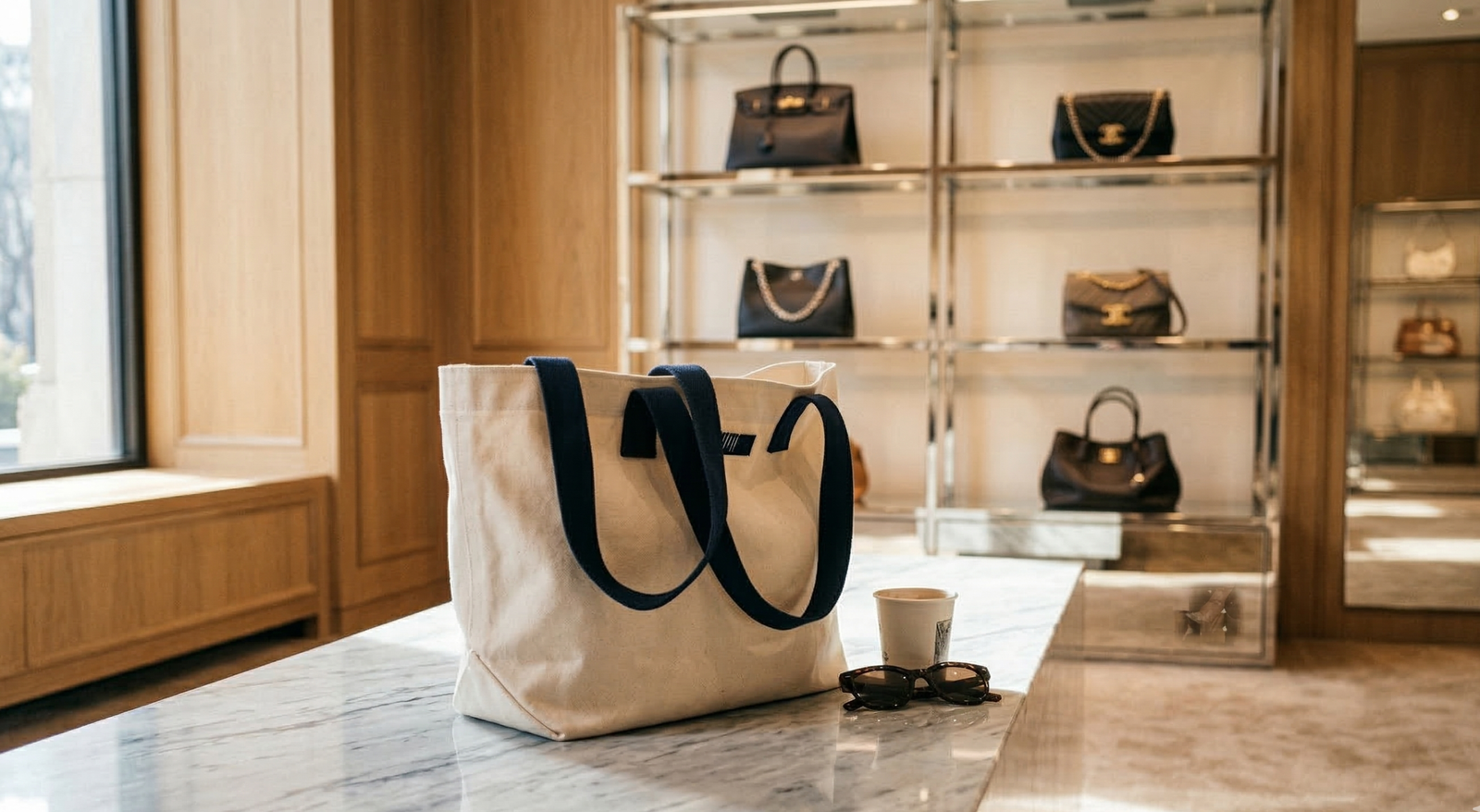
This is the story of the accidental it bag tote that disrupted luxury fashion. A $2.99 canvas tote is doing what $3,000 handbags can’t—generating real cultural belonging without a single influencer deal. And honestly? Luxury should be sweating.
Hear me out. Somewhere on Orchard Road right now, someone is carrying a bag worth about four Singapore dollars. Cream canvas. Navy handles. Red logo from an American grocery chain that doesn’t exist anywhere near this continent. Nobody gifted it to them in a PR package. No brand trip was involved. Someone just brought it back from San Francisco in a suitcase, and now it’s lowkey the most interesting accessory on the street.
Because in 2026, the Trader Joe’s tote bag has pulled off something that Hermès, Chanel, and Louis Vuitton pour billions into trying to engineer. It became scarce without trying. Desirable without marketing. And culturally relevant without anyone in a boardroom deciding it should be.
A $2.99 canvas shopping bag reselling for up to $10,000 on eBay and Korea’s Karrot marketplace isn’t just a quirky trend. It’s a full case study in what happens when accidental scarcity meets authentic identity signalling. And for the luxury fashion industry? It should be genuinely terrifying.
How a Grocery Bag Became the Accidental It Bag Tote of 2026
Let’s set the scene. Trader Joe’s is a 618-store American grocery chain that’s been selling reusable canvas bags since 1977. No international stores. No e-commerce. No shipping. When they drop a new bag design—mini totes, seasonal colourways, mystery packs—they don’t announce it. No countdowns. No influencer seeding. The bags just appear on shelves, and you either find one or you don’t.
This is literally the opposite of how luxury works. Every Hermès Birkin waitlist, every Supreme drop, every Nike SNKRS release is a carefully choreographed performance of scarcity. Trader Joe’s scarcity? It’s just… geography. There’s no strategy. The Pacific Ocean is the velvet rope. And consumers—especially younger ones who are fluent in detecting brand manipulation—can absolutely tell the difference.
The real breakout happened in 2024 when a limited-edition mini tote went viral and sparked Black Friday-level queues at a grocery store. By mid-2025, the standard navy-and-cream version was a global phenomenon—trending first in Japan’s “Americana-core” fashion scene, then rippling through Seoul, London, Melbourne, and eventually Singapore. Halloween-themed mini totes in October 2025 had people lining up before sunrise. By January 2026, eBay listings were hitting five figures.
The global collectibles market reached $306 billion in 2024, which proves people will pay wild premiums for things they perceive as genuinely rare. But the Trader Joe’s phenomenon adds a crucial nuance: that rarity has to feel real, not manufactured. Gen Z can smell a manufactured drop from orbit.
Geographic Exclusivity Hits Different
Here’s where it gets interesting for anyone who cares about how status actually works in 2026.
In cities where Trader Joe’s doesn’t exist—so basically everywhere outside the US—carrying the bag signals something very specific. You’ve either been to America, or someone who cares about you brought one back. That’s a layer of authenticity that no amount of money can replicate. A Birkin is exclusive because Hermès controls supply. A Trader Joe’s tote is exclusive because an ocean controls distribution. One is a game. The other is a genuine barrier. And that distinction matters.
Look at what’s happening in Singapore. On Carousell, the bags trade for around S$20—roughly five times the retail price, but nobody here is paying $10,000, because Singaporeans are pragmatic like that. But they’re still buying. University students. Office workers. Women in their sixties who saw the bag on their daughters studying abroad. The tote has collapsed generational boundaries in a way that luxury houses spend decades trying to achieve and mostly fail at.
Google searches for Trader Joe’s bags in Singapore went from literally zero before June 2024 to nearly 200 by January 2026. And the wildest part? The trend spread offline. Not through Instagram. Not through TikTok. People just noticed the bags on other people’s arms—on the MRT, at hawker centres, in office lobbies—asked where they came from, and requested one from anyone heading stateside. In 2026, in one of the most digitally connected cities on earth, a grocery bag went viral through word of mouth. That’s almost countercultural.
Cultural Capital > Financial Capital (And Luxury Should Be Worried)
This is where the luxury industry’s vulnerability gets real. The traditional luxury equation is pretty simple: you pay a premium for superior materials, craftsmanship, and the social signal that you can afford both. But when a $3 grocery bag generates more cultural prominence than a $3,000 handbag—when it sparks more conversations, builds more community, and says more about its carrier’s identity—that equation starts to fall apart.
Consumer psychology experts have identified the shift: people are increasingly buying signals of belonging rather than signals of wealth. The Trader Joe’s bag works as a “tribe marker”—a low-cost object that communicates taste, identity, and cultural connection more effectively than a logo-heavy luxury item ever could.
And here’s the paradox that makes it all work. Tote bags exist in this psychological space where they feel received rather than purchased. You “end up” with tote bags—subscription freebies, event giveaways, travel souvenirs. This gives the carrier an anti-consumerist alibi. You’re not shopping. You’re just carrying your groceries. The irony, obviously, is that this perceived authenticity is exactly what makes the bag desirable enough to command four-figure resale prices.
What separates Trader Joe’s from all of these is scale. It crossed from niche signifier to genuine mass phenomenon without losing its semiotic charge. The bag functions simultaneously as an earnest grocery carrier, an ironic fashion statement, and a legitimate status symbol. That layered contradictoriness is exactly how our generation relates to brands.
For anyone navigating the space between conscious luxury and cultural intelligence, the takeaway is clear: the next frontier of status isn’t about what you can afford. It’s about what you’ve experienced, where you’ve been, and which conversations you’re part of.
Four Things Luxury Should Learn (But Probably Won’t)
Organic beats manufactured. Trader Joe’s didn’t announce drops. Consumer discovery felt organic. Compare that to the increasingly formulaic luxury drop machinery—the pre-announcement, the countdown, the “leaked” campaign image. When something feels orchestrated, it loses the emotional charge that drives real desire.
Real scarcity beats fake scarcity. The 2025 Starbucks Bearista cup phenomenon proved this in parallel—a $30 cup triggered overnight queues because some stores genuinely received only one or two. Neither Trader Joe’s nor Starbucks optimised for virality. The products existed, became scarce through real constraints, and social media handled the rest. Trying to reverse-engineer this moment? Consumers see through it immediately.
Anti-design is the new design. The Trader Joe’s tote works aesthetically because it hasn’t been “updated.” The logo is retro. The typography is hand-painted. The colour palette is unapologetically old-school. In an era of perpetual rebranding and creative director musical chairs, the bag’s refusal to evolve gives it an authenticity that luxury branding struggles to match.
Community beats aspiration. When you spot another Trader Joe’s tote carrier in a city without stores, there’s an instant flicker of recognition—shared values, shared travel, shared cultural fluency. That feeling of kinship is something no logo can generate on its own. Luxury brands chase this through VIP programmes and ambassador deals. A $3 grocery bag achieves it accidentally.
So What Happens Next?
Every cultural phenomenon faces the same question: does going mainstream kill the magic? The New Yorker tote became so common it stopped meaning anything. Gentlewoman’s bags had a briefer, more intense cycle before the moment passed. Trader Joe’s is at the inflection point right now.
Spring 2026 will bring pastel-coloured micro totes, expected at $2.99 again. They’ll sell out instantly and resurface on resale platforms at absurd markups. Each new release extends the cultural conversation—but also risks diluting the scarcity that made the original special.
The smarter question isn’t whether the Trader Joe’s trend lasts. It’s what the phenomenon tells us about where desire is heading. If a $3 canvas bag can generate the cultural energy, community, and status signalling that luxury houses invest billions to produce, maybe the industry’s entire value proposition needs a rethink.
The bag will eventually fade. The insight won’t. In an era of performative everything, accidental authenticity is the scarcest commodity of all—and no marketing budget on earth can manufacture it.
The real question for luxury fashion isn’t whether they can create the next Trader Joe’s moment. It’s whether they’re brave enough to stop trying. For further reading, see Vogue.
For anyone navigating the space between conscious luxury and cultural intelligence, the takeaway is clear: the next frontier of status isn’t about what you can afford. It’s about what you’ve experienced, where you’ve been, and which conversations you’re part of.
Continue Reading

Lina, Founder, Creative Director & Editor-in-Chief
The mind behind Arahkaii. Lina launched the platform to spotlight the designers and brands she kept discovering and thinking “why isn’t anyone talking about this?” She brings a thoughtful, intentional approach to storytelling. She leads the editorial team with a focus on clarity, creative depth, and modern femininity, shaping narratives that feel both elevated and deeply human.She shapes everything from content strategy to editorial tone, is hands-on with every feature, and believes the best content makes you stop scrolling. Currently juggling platform-building, brand outreach, and defending her slow morning ritual as essential creative practice.

