
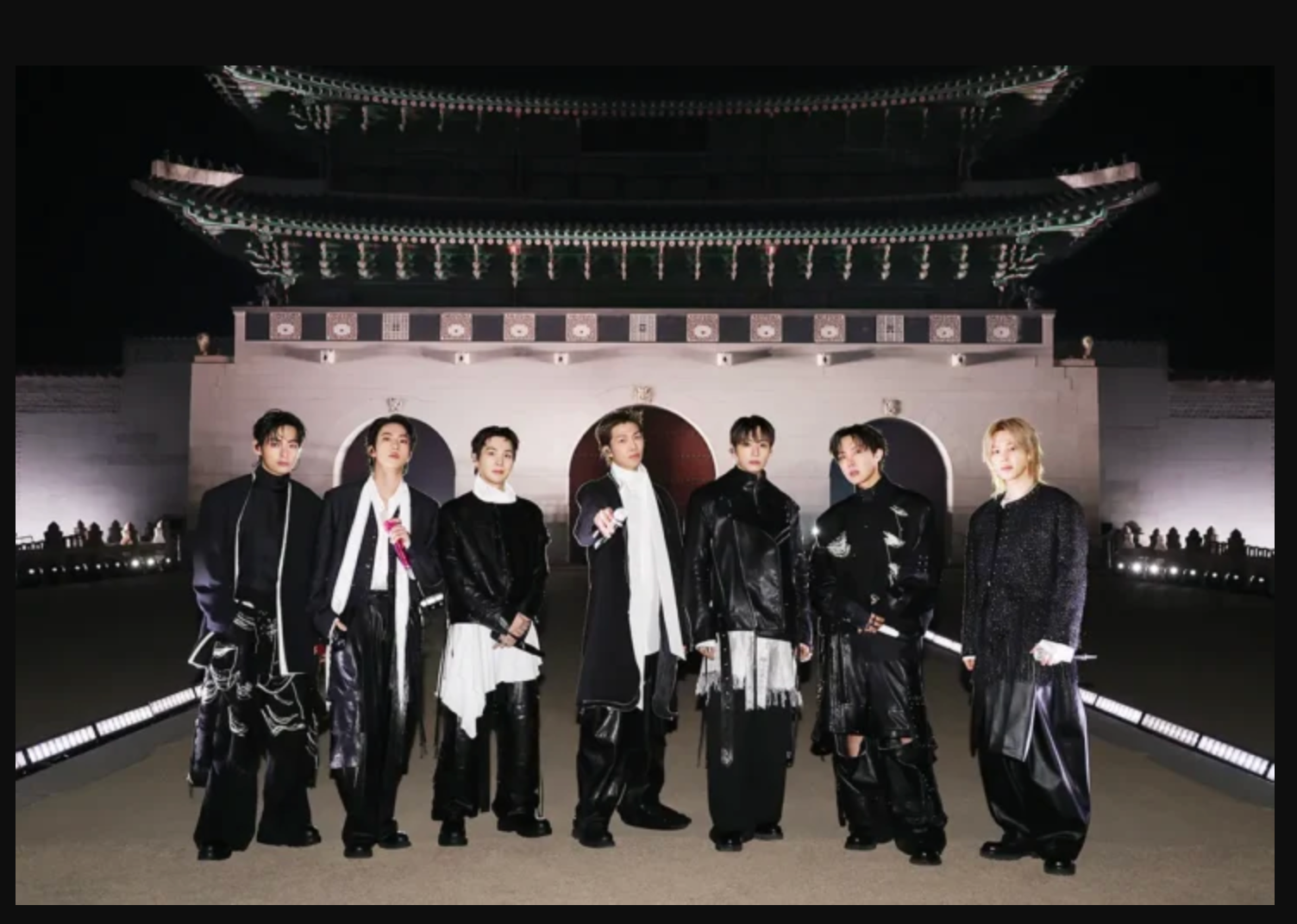
Songzio, the Seoul-founded Korean fashion house established in 1993, designed seven custom looks for BTS’s Arirang comeback concert at Gwanghwamun Square on March 21, 2026. The collection, titled “Lyrical Armor,” reimagines Joseon-era Korean garments and traditional armor through sculptural contemporary silhouettes — with each BTS member assigned a distinct archetype within a unified visual mythology. The decision to dress the world’s biggest group in an independent Korean label rather than the European luxury houses they individually represent is the most significant fashion statement in K-pop fashion history.
Let’s be clear — there are stage outfits, and then there are statements. What BTS wore at Gwanghwamun was the latter. Every single piece was custom-designed by Songzio, built specifically for the night, and rooted in traditional Korean dress reimagined through a monochromatic palette of black, white, and silver hardware. Not pulled from a stylist’s rail. Not borrowed from the luxury houses each member individually represents. Custom. Korean. Intentional.
What Is Songzio’s “Lyrical Armor” Collection for BTS?
Lyrical Armor is a seven-piece custom collection designed by Korean fashion house Songzio for BTS’s Arirang comeback concert. Creative director Jay Songzio drew from traditional Joseon-era garments and early Korean armor, then rebuilt those references into sharp, sculptural silhouettes that feel both ancient and futuristic. The collection’s name reflects its central concept: protection built not from metal but from meaning, poetry, and culture.
The brief from HYBE was deceptively simple: design something deeply, unmistakably Korean — not just Korean by nationality, but Korean in its bones. The album Arirang is named after one of Korea’s oldest folk songs. The concert was staged at Gwanghwamun Square, the symbolic heart of Seoul, against the backdrop of Gyeongbokgung Palace. Everything about the night was a statement about cultural identity, and the clothes needed to match.
Songzio’s answer was to look backward in order to look forward. Think dark, luminous fabrics that caught stage lighting like armor plating. Think structured shoulders that reference warriors without costuming. Think fluid layers that moved differently on each member, because each member was playing a different character in the story.
What Are the Seven BTS Member Archetypes in Lyrical Armor?
Songzio assigned each BTS member a distinct archetype within a single narrative framework, envisioning the group as heroes navigating turbulent times and leading toward a brighter future. Given that BTS had just completed military service and were returning to a K-pop landscape that had changed dramatically in their absence, the metaphor carried genuine weight. Here is how each archetype mapped onto each member.
RM — The Hero
The leader who carries the weight and sets the direction. RM’s look was the most structured and commanding in the collection — anchoring the entire group’s visual identity. He performed most of the night from a stool at the front of the stage after injuring his ankle in rehearsals, and that limitation made the “hero persisting through adversity” archetype land even harder.
Jin — The Artist
The archetype of creation and beauty rather than combat. Jin’s piece was the most ornamented of the seven — a reference to the Korean idea of the artist as a cultural custodian. His aesthetic has always leaned romantic and refined, and Songzio’s design honored that identity.
Suga — The Architect
If you know Suga’s work — the precision of his production, the structural clarity of his lyrics — this archetype writes itself. The architect doesn’t fight. The architect builds the frameworks that outlast the battle.
J-Hope — Sorigun (Sound Man)
The most playful archetype in the group. Sorigun is an old Korean term for someone who carries sound, who leads through rhythm — fitting for the member whose energy has always been BTS’s heartbeat.
Jimin — The Poet
Songzio described Jimin as “soft, with a lot of performance” — meaning he moves like language made physical. The poet’s armor is not blunt force; it’s precision, emotion, and meaning. Jimin’s look leaned into fluidity and layering more than any other member’s piece.
V — Seonbi (Nobleman)
Seonbi is a Joseon-era concept — a scholar-gentleman defined by learning, elegance, and moral integrity. V’s fashion identity has always gravitated toward clean, refined forms over maximalism, making this the most naturally aligned archetype in the collection.
Jungkook — The Vanguard
Dynamic, powerful, leading from the front. Jungkook’s archetype is the one that charges forward — which tracks perfectly for the member who built a global fanbase on raw physical presence and effortless cool.
How Did Songzio Solve BTS’s Biggest Design Challenge at Gwanghwamun?
Because the Arirang concert was held outdoors at Gwanghwamun Square, BTS could not perform traditional costume changes at any point during the show. For most performers, this would be a creative limitation. For Songzio, it became the most innovative constraint of the entire project — and arguably what elevates Lyrical Armor from a beautiful collection to a genuinely pioneering piece of stage design.
The solution was to build transformation into the garments themselves. Removable layers, shifting elements, and fabrics engineered to read differently under changing light conditions — the kind of design thinking that goes beyond aesthetics into something closer to architecture. As Songzio framed it, the question from the very beginning was: how do you make garments that can transform without the performer leaving the stage?
The answer is visible in the performance footage. The luminous material catches the blue wash during “SWIM.” The structured shoulders anchor the group formations. The whole visual world of the night was constructed so that the clothes were part of the choreography — not separate from it. This approach reflects a broader shift in how forward-thinking fashion houses are rethinking the relationship between garments and live performance.
Why Did BTS Choose a Korean Fashion House Over Their Luxury Brand Partners?
BTS members individually hold brand ambassador partnerships with seven of the most powerful luxury houses in the world: RM with Bottega Veneta, Jin with Gucci, Suga with Valentino, J-Hope with Louis Vuitton, Jimin with Dior, V with Celine, and Jungkook with Chanel. For their collective comeback — the most-watched K-pop event of 2026, broadcast live on Netflix to a global audience — HYBE chose a Korean independent house instead.
That decision is a statement with cultural weight. It says that when BTS needed to show the world who they are collectively, as a group, on the most symbolically loaded night of their career, they dressed in their own culture’s language. The luxury house partnerships reflect individual identity. The Songzio collaboration represents collective identity. The distinction matters, and it lands differently when you sit with it.
As we explored in our coverage of Southeast Asian fashion’s growing cultural confidence, the most powerful statements in fashion increasingly come from designers who root their work in specific cultural traditions rather than defaulting to Western luxury frameworks. BTS’s choice of Songzio is the highest-profile example of that shift to date.
Who Is Songzio? The Korean Fashion House Behind BTS’s Arirang Looks
Songzio is a Korean fashion house founded in Seoul in 1993 that bridges Korean aesthetic philosophy with Parisian avant-garde fashion. The brand sits alongside Wooyoungmi and Juun.J as one of the foundational names in Korean designer fashion — a house that has been showing at Paris Fashion Week since 2006, long before K-pop’s global influence made “Korean fashion” an internationally recognized category.
Under Jay Song’s creative direction since 2017, Songzio has grown from a commercially struggling label into a fashion house with over 120 points of sale worldwide, a Gangnam flagship store, and two locations in Paris’s Le Marais district. The brand’s ethos is rooted in what Jay Songzio describes as duality: East and West, traditional and avant-garde, structured and fluid — the same duality that defines BTS’s position in global culture.
The BTS moment at Gwanghwamun is not the beginning of Songzio’s story. It is a culmination of three decades of work that has consistently argued Korean design belongs at fashion’s top table. Similar to how Indonesian designers are building global relevance through cultural specificity, Songzio’s trajectory proves that fashion houses rooted in distinct local aesthetics can compete internationally without erasing their origins.
What Is the Korean Concept of Han and How Did It Shape Lyrical Armor?
Han is a Korean philosophical concept describing a deep, almost untranslatable feeling of collective sorrow, longing, and resilience woven through Korean history and culture. It is not sadness exactly — it is closer to grief that has been transformed into something enduring. The Lyrical Armor collection drew directly from han as its emotional foundation, and the concept maps almost perfectly onto what BTS’s return actually meant.
Four years of separation. Mandatory military service. A music industry that had changed around them. A fanbase that had grown from devotion into something closer to a generational identity. The clothes were designed to carry that weight — not literally, but conceptually. The idea of “lyrical armor” is exactly this: protection built from meaning, from poetry, from culture.
This is why the choice of Gwanghwamun as venue, the album title Arirang, the Joseon-era costume references, and the Korean folk musicians integrated into the performance all function as a unified argument rather than a collection of aesthetic decisions. Every element made the same claim: this is where we come from, this is who we are, and we are not going anywhere. It’s the kind of intentional cultural storytelling that separates meaningful fashion from mere spectacle.
What Comes Next: BTS Arirang World Tour 2026 and the Fashion Legacy
The BTS Arirang world tour kicks off in April 2026, spanning 82 shows across 34 cities globally. Singapore National Stadium dates are confirmed for December 2026. That represents an enormous number of stages, looks, and opportunities for the fashion conversation around BTS to evolve — but Lyrical Armor will remain the reference point for everything that follows.
The collection is the visual thesis statement for this era. Every subsequent tour look will be in conversation with it, whether leaning into its language or deliberately moving away. For Korean fashion designers broadly, the moment validates what independent houses have been building for decades: that there is a distinctly Korean aesthetic language that does not need Western luxury frameworks to legitimize it.
And for the global fashion world? The question of whether Korean-founded, Korean-aesthetic labels can claim a seat at the top table has been circling for years. On March 21, in front of 22,000 people at Gwanghwamun Square and a worldwide Netflix audience, Jay Songzio answered it definitively.
The armor wasn’t just lyrical. It was a declaration.
Frequently Asked Questions
Who designed BTS’s outfits for the Arirang comeback concert?
Korean fashion house Songzio, led by creative director Jay Songzio (Jay Song), designed all seven custom looks. The collection was titled “Lyrical Armor” and drew from Joseon-era Korean garments and traditional armor, reimagined through sculptural contemporary silhouettes in a monochromatic black, white, and silver palette.
What are the seven BTS member archetypes in Lyrical Armor?
Songzio assigned each member a unique archetype: RM as the Hero, Jin as the Artist, Suga as the Architect, J-Hope as Sorigun (Sound Man), Jimin as the Poet, V as Seonbi (Nobleman), and Jungkook as the Vanguard. Each archetype was rooted in Korean cultural concepts and reflected the member’s individual personality and artistic identity.
Why did BTS choose Songzio over their individual luxury brand partners?
BTS members individually represent Dior, Celine, Chanel, Louis Vuitton, Gucci, Valentino, and Bottega Veneta. For their collective comeback, HYBE chose Korean independent house Songzio to make a statement about cultural identity — the individual luxury partnerships represent personal style, while the Songzio collaboration represents collective Korean identity on the world stage.
What is Songzio and when was it founded?
Songzio is a Korean fashion house founded in Seoul in 1993. Under Jay Song’s creative direction since 2017, it has grown to over 120 points of sale worldwide with a Gangnam flagship and two Paris stores. Songzio has shown at Paris Fashion Week since 2006 and bridges Korean aesthetic philosophy with avant-garde design.
When is BTS’s Arirang world tour in 2026?
The BTS Arirang world tour begins in April 2026, covering 82 shows across 34 cities. Singapore National Stadium dates are confirmed for December 2026.
What is the Korean concept of han in the Lyrical Armor collection?
Han is a Korean philosophical concept describing collective sorrow, longing, and resilience transformed into something enduring. Songzio used han as the emotional foundation of Lyrical Armor, reflecting BTS’s four-year separation during military service and the weight of their return as a cultural moment.
Related Reading on arahkaii
- Jakarta Fashion Week 2025: The Designers Redefining Southeast Asian Fashion
- Sukkhacita: How Regenerative Fashion Is Reshaping Indonesian Artisan Economics
- The Rise of Modest Streetwear in Southeast Asia
- Batik Meets Blockchain: Indonesian Textile Authenticity in the Digital Age
- The Conscious Luxury Manifesto: Redefining Sustainable Living
- From Followers to Founders: Creators Building Empires Beyond the Algorith
Nadra
Co-Founder & Head of Content
The Gen Z co-founder behind Arahkaii’s content strategy. She shapes stories that feel elevated yet genuinely worth reading — modern, meaningful, and thoughtfully crafted. Nadra oversees editorial standards and ensures everything published reflects real quality, not just what’s trending.
When she’s not editing or building the platform, she’s hunting for vintage finds, curating playlists to match the vibe, or getting lost in a good book — always on the search for the city’s best matcha.

